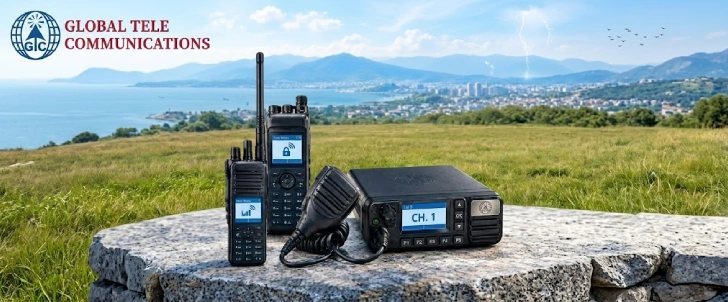
Motorola Portable Wireless Radios Dealers in India
Global Tele Communications caters to business communication requirements by helping organizations explore portable wireless radio solutions for coordinating teams, managing operations, and maintaining communication across work areas. Motorola portable wireless radios are used in various professional environments where dependable two-way communication is important for daily activities.
Businesses searching for Motorola portable wireless radios dealers in Indi often need suitable communication equipment for security teams, industrial facilities, construction sites, hospitality operations, warehouses, and event management. Selecting the right radio depends on coverage requirements, operating conditions, battery performance, audio clarity, compatibility, and the intended application.
Choosing an appropriate portable radio solution helps organizations coordinate staff, communicate operational updates, and respond to routine situations efficiently. Before purchasing, buyers should verify the exact Motorola model, technical specifications, frequency requirements, regulatory compliance, and available accessories.
What Are Motorola Portable Wireless Radios?
Motorola portable wireless radios are handheld communication devices designed to transmit and receive voice messages over compatible radio systems. Depending on the model, they may use analog or digital radio technology and operate on supported frequency bands.
Unlike communication systems that rely on cellular coverage, conventional two-way radios can communicate directly between compatible units when they are within suitable operating range. Actual performance depends on the radio model, antenna, terrain, buildings, interference, and other environmental conditions.
How Do Portable Wireless Radios Work?
A user speaks into the radio's microphone and transmits a message using the push-to-talk (PTT) control. Other compatible radios tuned to the appropriate channel can receive the transmission. Some systems support additional features, such as group communication, digital audio, emergency alerts, or repeater connectivity, depending on the model and configuration.
Why Choose Motorola Portable Wireless Radios?
Motorola offers professional communication products for different operational needs. The appropriate model should be selected according to the environment, communication requirements, and applicable technical specifications.
Reliable Team Communication
Two-way radios help teams exchange instructions without needing to make individual phone calls. This can be useful in facilities where employees must communicate quickly while continuing their work.
Professional Communication Options
Depending on the product range, buyers may choose radios with analog or digital capabilities, different battery configurations, audio accessories, and supported communication features.
Convenient Portable Design
Handheld radios allow employees to carry communication equipment while moving between departments, buildings, workstations, and outdoor locations.
Options for Different Industries
Different Motorola radio models are designed for different usage scenarios. Buyers should compare the available range, durability, controls, battery performance, and connectivity options before making a selection.
Key Features of Motorola Portable Wireless Radios
Depending on the particular Motorola model, different functions are available. Common features across relevant professional two-way radio ranges may include the following.
Push-to-Talk Communication
The push-to-talk function allows users to transmit voice messages by pressing a dedicated button. This supports straightforward communication between compatible radios.
Clear Audio Performance
Suitable audio output and noise-management features can help users understand messages in busy workplaces. The model and ambient noise levels have an impact on audio performance.
Analog and Digital Radio Options
Some Motorola radios support analog communication, while others provide digital functionality. Certain models support both modes, but compatibility must be checked before integrating new radios with an existing system.
Rechargeable Battery Options
Portable radios commonly use rechargeable batteries. Battery capacity and operating time vary with the model, battery condition, transmission frequency, and accessory usage.
Channel Selection
Supported channel configurations help teams organize communication for different groups or operational tasks. The available channels and permitted frequencies depend on the device and applicable regulations.
Communication Accessories
Depending on compatibility, accessories may include earpieces, headsets, speaker microphones, chargers, spare batteries, and carrying attachments.
Durable Construction Options
Certain models are designed for demanding work environments and may offer specified resistance to dust, water, or physical impact. Buyers should check the exact model's published protection ratings rather than assuming all radios have the same durability.
Benefits of Motorola Portable Wireless Radios
Improved Operational Coordination
Portable radios help employees exchange instructions, report progress, and coordinate activities without repeatedly leaving their workstations.
Faster Information Sharing
Push-to-talk communication provides a direct way to share short operational messages with compatible users. This can be useful for task allocation, logistics, and routine coordination.
Support for Group Communication
Teams can coordinate work across departments and specified operating zones with the use of compatible radio systems, which enable communication over shared channels.
Mobility Across Work Environments
Handheld radios allow staff to remain connected while moving through warehouses, industrial premises, hotels, campuses, and event venues, subject to the radio's effective coverage.
Potentially Lower Dependence on Cellular Networks
Direct radio communication between compatible units may operate without a cellular network. However, repeater-based systems, network-connected radios, and advanced communication services may require additional infrastructure.
Technical Specifications of Motorola Portable Wireless Radios
Technical specifications differ across Motorola product families and individual models. The following points identify the main specifications buyers should verify before purchasing.
- Brand: Motorola, subject to confirmation of the exact product and model.
- Device Type: Portable handheld two-way radio.
- Radio Technology: Analog, digital, or dual-mode, depending on the model.
- Frequency Band: Model-specific; confirm the supported frequency range and authorized use in India.
- Channel Capacity: Varies by model and programming configuration.
- Communication Range: Depends on the radio, antenna, terrain, buildings, interference, and whether repeaters are used.
- Audio Output: Varies by model and supported speaker or audio accessory.
- Battery Type: Rechargeable battery type and capacity depend on the selected model.
- Battery Operating Time: Model-specific and affected by transmission patterns, settings, battery condition, and accessories.
- Display and Controls: Some models have displays and programmable controls, while simpler models may use basic physical controls.
- Durability Rating: Check the model's official IP rating or other published durability specifications, where applicable.
- Connectivity and Compatibility: Confirm supported analog or digital standards, accessories, repeaters, and existing radio-system compatibility.
- Charging Options: Confirm compatible chargers, charging accessories, and spare battery availability.
- Operating Environment: Check the manufacturer's stated operating temperature and environmental limitations.
- Regulatory Compliance: Verify applicable Indian frequency authorization, equipment requirements, and other relevant regulatory conditions before deployment.
Applications of Motorola Portable Wireless Radios
Portable wireless radios support communication across a wide range of professional environments.
Security and Facility Management
Security personnel use compatible two-way radios to coordinate patrols, communicate access-related updates, and share routine operational information across a facility.
Construction Sites
Construction teams can use radios to coordinate workers, communicate between work areas, and share updates about ongoing activities. Equipment selection should reflect site conditions and the required communication coverage.
Manufacturing and Industrial Facilities
Factories and industrial units can use portable radios for communication between supervisors, production teams, maintenance staff, and warehouse personnel.
Warehousing and Logistics
Warehouse operators, inventory teams, loading staff, and logistics coordinators can use radios to exchange instructions and coordinate material movement.
Hotels and Hospitality
Hospitality teams may use portable radios to coordinate housekeeping, maintenance, security, and event-support activities.
Event Management
Event organizers and venue teams can use radios to coordinate staff, communicate schedule updates, and manage operational tasks across event areas.
Educational Institutions and Campuses
Authorized campus operations teams may use suitable radio systems to coordinate maintenance, facilities management, and security activities.
Retail and Commercial Facilities
Large retail stores, shopping centres, and commercial facilities may use radios to coordinate employees, manage deliveries, and communicate routine operational information.
How Global Tele Communications Can Help
Global Tele Communications can be approached to discuss Motorola portable wireless radio requirements and identify suitable options based on the intended application. Buyers should confirm the availability of specific models, accessories, warranty conditions, and technical support directly with the company.
Providing information about the number of users, work environment, required coverage, and existing equipment can help narrow down the suitable product options.
Frequently Asked Questions About Motorola Portable Wireless Radios
1. What are Motorola portable wireless radios used for?
They are used for two-way voice communication in settings such as security, manufacturing, construction, hospitality, warehousing, logistics, and event management.
2. Where can I find Motorola portable wireless radios dealers and suppliers in India?
Businesses can contact communication equipment suppliers, request the exact model number, and verify product authenticity, availability, warranty, technical support, and regulatory compliance before purchasing.
3. What is the communication range of Motorola portable radios?
Range varies according to the model, frequency, antenna, terrain, building structures, interference, and use of repeaters. Buyers should assess the intended site rather than relying on a single advertised distance.
4. Do Motorola portable radios support digital communication?
Some Motorola models support digital radio technology, while others are analog or support multiple modes. The exact model specification should be checked to confirm compatibility.
5. How long does the battery last on a portable wireless radio?
Battery operating time depends on the model, battery capacity, usage pattern, transmission frequency, and environmental conditions. Refer to the manufacturer's specifications for the selected device.
6. Can Motorola radios be used in industrial environments?
Yes, suitable models can be used in industrial settings, provided their technical specifications and durability ratings match the environment. Special hazardous locations require equipment specifically approved for those conditions.
7. What should I check before buying Motorola two-way radios in bulk?
Confirm the model, quantity, frequency authorization, coverage requirements, battery and charger compatibility, accessories, warranty, product documentation, and after-sales support.
8. Are licenses or approvals required to operate portable wireless radios in India?
Requirements depend on the frequency band, equipment type, and intended use. Buyers should verify applicable Department of Telecommunications and Wireless Planning and Coordination requirements before purchasing or operating radio equipment.